Tuesday, May 17, 2011

Happy fourth birthday to The Bike-sharing Blog!

Where has all the time gone? The Bike-sharing Blog was born four years and 275 posts ago today. That’s sharing about 69 posts per year. Russell and I combined don’t even brush our teeth that often in a year.

As we enjoy the sugary icing of the Blog’s birthday cake, we thank you for your continued reading of our little Blog. And here’s to everyone who is making bike-sharing happen in their city or town, campus, park, or office park! We look forward to all the exciting developments on which we will be writing about in The Bike-sharing Blog’s fifth year.

Sincerely,

Paul DeMaio and Russell Meddin, The Bike-sharing Blog co-authors

p.s. – Paul is the good-looking guy with curly hair on the left and Russell is debonair guy on the right. And no, we’re not wearing spandex.


Monday, May 16, 2011

Now That's Data

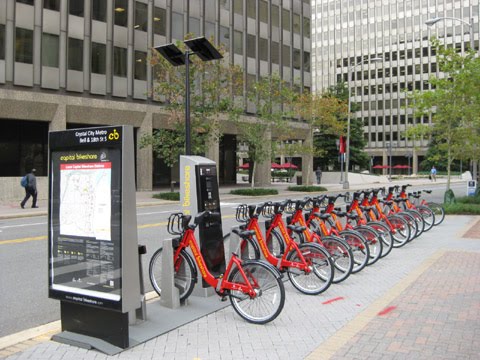
Capital Bikeshare (Washington, DC & Arlington, VA - USA) launched its dashboard, or snapshot of key service performance measures, today. The dashboard is full of useful data from the service and I believe one of the best sites of its kind provided by any government offering a bike-sharing service. Data on a public service should be easily accessible and informative and this site certainly is.

For Immediate Release

Monday, May 16, 2011

Capital Bikeshare Launches New Performance Dashboard

(Washington, D.C.) Capital Bikeshare launched a new website today that provides a wealth of performance data about the bikesharing program, including monthly statistics for ridership, membership, customer service, fleet performance and safety.

The Capital Bikeshare dashboard is available at cabidashboard.ddot.dc.gov. It was developed by the District Department of Transportation (DDOT) as part of the agency’s continuing effort to improve transparency and release performance data related to its transit services.

“This new dashboard unleashes the data that we have accumulated with each electronically-recorded Bikeshare trip,” said DDOT Interim Director Terry Bellamy. “We encourage our members, casual users and anyone interested in the system to review, analyze and download the information and provide us with your feedback.”

The dashboard features 18 individual performance metrics, which fall under four categories: Ridership, Fleet Performance and Safety, Customer Service and Membership. Performance metrics include: Trip Origin/Destination by Station; Trip Origin/Destination by Municipality; Fleet Maintenance (Number of bikes inspected/repaired) per month; Rebalancing (Number of times bicycles picked up and dropped off at stations); and total number of users. The data covers the entire Capital Bikeshare system, including the District and Arlington.

Through this portal, the public will be able to review system-wide information, compare performance metrics by different time intervals, and download data for individual custom analysis.

In order to guide users through the site, DDOT has prepared an online Dashboard Tutorial, which is available on DDOT’s YouTube Channel, providing a voice-narrated, step-by-step overview of how to use the Dashboard and maximize its features.

Preceded by the Circulator Dashboard, the first dashboard of its kind in the Washington Metropolitan region, the Capital Bikeshare dashboard’s creation is a reflection of DDOT’s continued commitment to transparency, government accountability and best practices. The information and data contained in the dashboard is scheduled to be updated on a monthly basis.

For any inquiries about the dashboard, users are asked to contact DDOT via email at cabidashboard@dc.gov.

Capital Bikeshare is the product of a unique public/private partnership between DDOT, Arlington County and Alta Bike Share. The two jurisdictions worked closely with Alta Bicycle Share to develop the program in the fall of 2010, offering regional service with 1,100 bikes and 114 stations. Based on the initial success of the program, both jurisdictions plan to add additional stations and bicycles to the system by the end of the year.


Saturday, May 14, 2011

Ljubljana gets on its BICIKEL(LJ)

BICIKE(LJ), Slovenia's new bike-sharing service, launched May 12th in the capital of Ljubljana. Its name is a combination of a word "bicikel" (which I'll let you guess what it means in English) and "LJ", which is the registration motor vehicle mark and initial letters of Ljubljana. Customers will be able to pick up one of 300 bicycles from any of the 31 stations covering an area of approximately 12 square kilometers in a network where the terminals are not separated by more than 500 meters. The population of Ljubljana is 275,000 with at least 100.000 daily commuters and 45,000 students.

The service is a joint venture of the Municipality of Ljubljana and the advertising company Europlakat (a partner of JCDecaux in Slovenia). Even before the launch, 1,633 advance registrations had been made through their website -- http://en.bicikelj.si/. Registration is available for a year at three euros and a week at 1 euro. The first hour is free of charge, the second is 1 euro, third is 2 euros, and each additional hour is 4 euros. The service is operable 24 hours per day throughout the year.

Special thanks to Janez Bertoncelj, Ljubljana's cycling coordinator for assistance with this article.

Wednesday, May 4, 2011

The Bike-sharing World: First Week of May 2011


Because the Northern Hemisphere is basking in warm weather, bike-sharing systems are blooming all over that part of the world.

The beginning of May has brought the official opening of Tel-Ofun in Tel Aviv, Israel. Watch video.

Yesterday morning bIXI hit the streets of Toronto, Canada. With 1,000 bikes in 80 stations, Toronto bIXI will be the 3rd largest system in North America! Bike-sharing is making big strides in Canada. Watch this news report


Later this week Nuremberg's NorisBike starts on May 6th. This is another system using neXt bike technology. Bike-sharing is expanding and evolving in Germany. Many programs are now establishing specific location docking stations and adding subscriber card and credit card access as well as telephone access to the bikes. Berlin's new Deutsche Bahn StadtRAD begins May 20th.


May 20th is also the official start date for Hawaii B-cycle although the two stations are now in use. Boulder B-cycle also starts on May 20th opening with 12 stations and expanding to 15 with 150 bikes by the end of summer.

Keep your eyes open, because there are more buds of bike-sharing systems ready to show their pedals and blossom into full service.

Saturday, April 30, 2011

Vancouver Readies for 2012


The City of Vancouver, Canada has a Request for Expressions of Interest (RFEOI) out for a company "to develop, install, own, operate and finance a Public Bicycle System (“PBS”)... targeting launch in Spring 2012 or earlier." (It's interesting that there happens to be a company named Public Bicycle System Company that is also in Canada. Merely a coincidence tho'.)

It's interesting to see cities are getting smarter and turning the outdoor advertising business model of bike-sharing on its head. Instead of cities doing a public tender for an outdoor advertising program and getting a "free" bike-sharing service, the trend is to now to do a public tender for bike-sharing through a bike-sharing service contract and getting it for free. It keeps things simpler and the revenues cleaner.

Pedal hard, Vancouver! The service should be up and running in time for your hosting of the Velo-city Global conference in Spring 2012.

image: Destination360

Friday, April 29, 2011

Royal Bike-sharing

We all know that one feels like royalty while bike-sharing. Now the Royals will also know that feeling too. London Mayor Boris Johnson gave a special tandem "Boris Bike" to Prince William and Kate Middleton as a royal wedding gift. We understand that, not standing on ceremony, the Royal Couple will pay £2 a day rather than the normal £1 a day for casual use!

The special built 7-speed tandem was made by Cycle DeVinci, the company which makes the bicycles for Public Bike System Company, the suppler to London's Barclays Cycle Hire. It was commissioned by SERCO -- the system's operating company. Mayor "Boris" presented the bike as a wedding gift from the people of London during an open air ceremony at Trafalgar Square this morning as many "Boris Bikers" watched the royal procession on a giant video screen.


Thursday, April 21, 2011

Hubway Coming to Boston Area


This afternoon Boston signed the deal to bring bike-sharing to the Massachusetts Bay Area. With the goal of making a regional system, Boston will start Hubway, the name of its bike-sharing service in July with 600 bikes in 61 stations. The neighboring Cambridge, Brookline and Somerville communities are expected to join Hubway within the year and other communities to follow soon thereafter to ultimately have 5,000 bikes throughout the region with 300 stations. The system will use the Public Bike System Co. equipment, the same as in Washington, DC; Minneapolis; London; Melbourne; and Montréal. It will be operated by Alta Bicycle Share of Philadelphia which also operates the Washington, DC and Melbourne, Australia programs. The yearly subscription membership is pegged fairly high, at $85 which is $25 more a year than the comparable Nice Ride Minnesota and $10 more than Capital Bikeshare. The daily fare for casual users is the same as Minneapolis and Washington at $5.

The Boston-area athletic shoe company, New Balance, will be a major sponsor and has retained the naming rights to the system, according to a City of Boston press release. New Balance Hubway should be an interesting name for bike-sharing service considering bike balancing is a major element of every service.

image: The Bike-sharing Blog

Russell Meddin bikesharephiladelphia.org

Thursday, April 7, 2011

The Bike-sharing World: First Week of April 2011

Velib'

Europe: The Price of Success

On April 15th, with the approval of the Parisian City government, a revised rate structure for Vélib' begins with many good additions. The current annual subscription of 29€ ($41.50 US) with the first 30 minutes free each time the bike is used remains the same. A new 39€ ($55 US) subscription with 45 free minutes instead of 30 free minutes will induce suburban users to ride longer to work, school, or even further into the city. There is an advantageous subscription for young people under 26 years of age which gives them 45 minutes free instead of the 30 minutes free, but at the same price of 29€ per year subscription. Also there is a new scholastic tariff for students under 26 years of age which affords them a discount of 10€ off the price of a regular annual subscription. A new "formula touristic" allows people holding a credit card without a "chip" (that is most North Americans) to register online or at certain outlets (hotel, tourist office, etc.) in Paris for the 1-day or 7-day pass. The single 1-day pass is now the same price as a single one-way Paris Metro or bus trip 1.70€. This is excellent pricing for making an effective cost connection between bike-sharing and other forms of public transit. The 7-day pass is 8€ ($11.50US). The Vélib' web site will be more user-friendly making it easier to subscribe for all levels, from daily to annuals, online and for users to find locations to activate memberships and download maps. With almost 100,000,000 Vélib' trips since July 15, 2007 this programs success has been priceless.


North America: Bike-sharing wakes up from a long winter's nap

With in the next week, both Montréal' s bIXI and Minneapolis' Nice Ride will be back on the streets after hibernating for the winter. Nice Ride plans on starting its second season on April 11 with eight new stations in north Minneapolis and plans to have 100 stations this summer to include service in downtown St. Paul. They are offering a great way to shake off the cold Minnesota snow with a special limited time $40 annual subscription sale that is $20 off the regular price . bIXI will open its 400 stations in Montréal on April 15. The last few weeks have seen the stations back in places all over their service area. Five new stations are planned for an expansion of the system into Westmount this season. Les Montréaleurs are ready to roll. Capital Bikeshare, however, has beaten winter by rolling throughout the cold months creating scores of winter weather warriors.

images: Bike-sharing Blog, Nice Ride, and bIXI

Russell Meddin bikesharephiladelphia.org

Friday, April 1, 2011

4th Gen Bike-sharing has Arrived

The Bike-sharing Blog has its finger on a scoop that no other media outlet has been able to obtain. Forty-six years after the innovative concept of bike-sharing was first created, the fourth generation of bike-sharing has finally arrived!

No more smartcards, mobile phones, or keys are needed with this new technology as all it requires is a chip which is implanted into the customer’s skin. Germany’s Call a Bike system is taking advantage of Canada-based Melanin, Inc.’s high-tech innovation, the IntelliFreckle. The IntelliFreckle is the size of a grain of rice and can be inserted under a customer’s skin through a painless air pump, found at each station.

Deutsche Bahn, the provider of Call a Bike is the first to integrate this biochip into its service to be used in 68 cities where its offerings are already in place. The new service is to be called “Rub a Bike”, named after the action a customer with the biochip must do in order to rent one of the fleet’s bicycles.

To unlock a Rub a Bike, one must rub the body part with the inserted chip directly over the RFID reader on the dock in any stand where a bicycle is parked. A thumbs up image is displayed on the dock with five seconds of the 1984 hit tune “99luftballons” played from speakers on the bike which will signal to the customer that their identification has been accepted and the bike is ready for use.

With the technology being new, there is a rub with some aspects which still are being tweaked. For example, clothing can get in the way of the dock’s reader and the IntelliFreckle chip, so the manufacturer recommends inserting the chip into a location on the body that is not normally covered by clothing. IntelliFreckle’s inventor, Hugh G. Mole, who graduated from McGill University in Montreal stated, “The buttocks and torso are generally not good locations for the chip. The back of the hand works very well, however, due to its extended nature, it seems the middle finger works the best.”

Happy April Fools’ Day from The Bike-sharing Blog! This blog post is a joke, but probably will be true someday.

Monday, March 21, 2011

OBIS Project Final Project and Conference


The OBIS Project (Optimizing Bike Sharing in European Cities) is wrapping up soon and their final conference is set for June 21 in Prague to discuss their findings. Here is their latest:

"Bike sharing schemes are an essential part of today’s mobility landscape. The three largest bike sharing schemes in Europe are used for trips equivalent to going around the world ten times each day (see below). OBIS research revealed that between 10% and 20% of bike sharing trips replace car or taxi trips in some schemes. Thus the schemes contribute to healthier, cleaner and more sustainable urban mobility.

"The OBIS project team had a close look at more than 50 European bike sharing schemes during almost three years of project work. A complete handbook- the first of its kind-provides recommendations for authorities and practitioners. Recommendations cover the implementation and optimisations processes for bike sharing schemes from scratch. Technical solutions are presented and compared; different service designs are set into the context of city features (e.g. topography, climate, cycling culture) and optimisation approaches in terms of technology and service levels are described.

"The project team will present the handbook at the final project conference in Prague on 21st June 2011. The handbook presentation will be accompanied by presentations of various schemes such as Barclays Cycle Hire (London), Bicing (Barcelona), BikeMi (Milan), Call a Bike (Berlin), City Bikes (Stockholm), Leihradl-nextbike (Austria) and CD Bike (Czech Republic). Interested stakeholders are invited to register until 31st March 2011. Participation is free of charge but seats are limited. More information can be found on www.obisproject.com."

Photo credit: Tim Birkholz, choice GmbH

Thursday, March 17, 2011

Thanks a Million!


With The Bike-sharing World Map's 1,000,000th page view within reach, its popularity has far exceeded our expectations. When I founded The Bike-sharing Blog in May 2007, it quickly became evident that The Blog needed a companion graphic to track the growth of the field in a complementary way. So in October 2007, I launched The Bike-sharing World Map to compile all the cities planning and launching a service that I wrote about in the Blog. Not too long after the Map was created, this companion piece took over as the more often viewed site and the Blog actually became the companion to the Map! Russell Meddin joined me in 2008 and assists in keeping the Blog and the Map up-to-date in the rapidly changing world of bike-sharing where new services seemingly launch every week.

We thank our readers for supporting both The Bike-sharing World Map and The Bike-sharing Blog and look forward to the next million views and all the new services that will come on-line during that time.

Tuesday, March 15, 2011

DecoBike a concession to the Art Deco of Miami Beach

Today in Miami Beach, Florida, an experiment in bike-sharing begins. DecoBike starts its operation in what is considered the crossroads of North and South America. A city of almost 90,000 people will have 1,000 DecoBikes in 100 DecoStations making it the service with the best ratio of bikes to population in the Americas. DecoBikes takes its name as a nod to the Art Deco buildings along the beach.


The service is not part of a street furniture contract, nor is it run by a non-profit that oversees operations for the city, nor it is a public-private scheme, nor is it a publicly owned and funded system. It will be one of the few services set up totally as a private venture as it is run as a concession within the city. In fact, as a private venture, the company already has all of the DecoBikes sponsored by KLM-Air France to publicize its upcoming new air service from Miami to the world bicycle capital, Amsterdam!


With a concentration of stations, the service is made to work for both residents of Miami Beach and the many tourists that seek its Art Deco hotels and warm beaches. The pricing for using the service differs from most other bike-sharing programs. For residents, the longest term for a membership is monthly at $15. There is no yearly membership. For both residents and tourists, there is a daily access pass for $14, a 3-day access pass for $30 and a special 5-day access pass for $49. All of these passes allow unlimited trips during the term with each trip 30 minutes or less at no charge. Each additional 30 minutes is billed at $4. The stations not only allow sign-ups for access passes, but also allow the borrowing of a DecoBike on an hourly basis. The hourly rate is thirty minutes for $4, sixty minutes for $5 and 120 minutes for $10, in each case, it is a single use. Most of these options are available at the easy-to-use stations.


Now with bike-sharing in sunny Florida, those bike-sharers whose services hibernate for the winter will have a place to enjoy the beach and the bikes.

images: DecoBike

Russell Meddin bikesharephiladelphia.org

Thursday, March 10, 2011

The Bike-sharing World: March 2011

Europe:
StadtRad in Hamburg, Germany adds better functionality to its bike-sharing system making it easier to pick up and return a bike. In this bike-sharing era, there is much talk about smart mobile phones accessing new P2P (peer to peer) and social bike systems where no stations are necessary (i.e. "flexible" systems). In Germany where Call-a-Bike and nextbike have been mostly accessed by mobile phone, the newer systems such as StadtRad in Hamburg and Berlin have now added walk up kiosks as well. Beginning the first of this month in Hamburg, an RFID (radio frequency ID) membership card can be tapped on a bike's lock to release it. Tap the lock again with your RFID card when the bike is returned to lock the bike at any of the stations. Also, in Mainz, Germany, a system of 1,000 bikes in 120 stations, similar to StadtRad Hamburg, is currently under construction.

Nuremberg, Germany also starts a new RFID card system in two months. NorisBike will have 750 bikes throughout 65 stations. As attractive as smart phone based bike-sharing seems, the country that has used telephone bike-sharing for years is now moving to incorporate card-based kiosk stations to better serve its cities.

Europe-Australia:
Our friend Mike Rubo of the Sit-up cycles blog has made a new film with inciteful interviews from Barcelona's Bicing system. It explains how this system should be used as a model to improve bike-sharing in his native Australia.


In North America:
The Ides of March will grab lots of eyes as the sexiest bike-sharing system, DecoBikes, starts in Miami Beach Florida. Grab you bathing suit and take a ride on South Beach and enjoy the scenery!

Bike-sharing to return to Ottawa- Gatineau, Canada this May after a one year hiatus. The National Capital Commission (NCC) has approved a Capital bIXI system with 10 stations and 100 bikes for Canada's seat of government. NCC hopes to increase the size of the system to 500 bikes and 50 stations. Capital bIXI and Toronto bIXI will join Montréal bIXI in Canadian bike-sharing this year.

Crain Business News is reporting that Alta Bicycle Share and Trek B-cycle as finalist in the running for the New York City Bike-sharing contract for a system to begin late this fall or early next year.

Friday, March 4, 2011

5 Things Every Mayor Should Know Before Starting a Bike-sharing Service

Interest in bike-sharing services is growing around the world. With each successful service, there is more interest from communities within a region, state, province, and country for more bike-sharing services. Before implementing a bike-sharing service, it’s important for public officials and staff to consider the following:

1) Be a bike-friendly community first.

Your community should be bike-friendly first with a dense network of bike facilities, such as cycle tracks, bike lanes, and trails. This network of bike facilities will enable bicycle riders and your future bike-sharing customers to easily and safely travel through your community by bike. The League of American Bicyclists’ Bicycle Friendly America Yearbook offers examples of what other communities have done to become bike-friendly. Many communities with bike-sharing services also have high Bicycle Friendly Community ratings and include: Arlington, VA, Washington, DC, Minneapolis, and Denver. As you implement a bike-sharing service, your community should strive to be at least a bronze-level Bicycle Friendly Community.

2) Bike-sharing is not cheap, so secure sufficient funding.

By implementing a bike-sharing service, you’re launching a new transit service. It may be less expensive to purchase and operate than a bus or rail service, but sufficient funding is required to make it successful. While the types of bike-sharing systems vary, costs can be up to $5,000 per bike for capital and operating expenses can range from $100 - $200 per bike per month. A service with a couple hundred or thousand bikes is pricey. However, while implementing a service is not cheap, bike-sharing can be a cost-effective public transport option.

3) Size and density matter.

A bus service with a solitary bus or just a couple of stops will only be accessible by a limited number of people—those living, working, or playing near the stops. The same can be said for bike-sharing, as the greater the number of bikes and the wider the network of stations translates into a more successful service. Station density should be such that a customer can find a station every couple of blocks. In fact, a bike-sharing service’s usefulness will increase geometrically with each additional station as each station expands the reach of your service by better connecting places into this new transit system.

4) Get private sector sponsors.

Bike-sharing lends itself to public-private partnerships. Private organizations can assist the implementing agency by sponsoring the service or purchasing a station for outside of their worksite. They also find bike-sharing good for providing their employees a healthy commuting option, making their location more accessible to customers, being environmentally healthy, and promoting a green service. The public benefits by having some of the costs of buying and operating a service covered by private organizations. Whether the implementing agency is a local government or non-profit, both have successfully taken advantage of sponsorship to help expand their service’s reach. Barclays Bank sponsored Barclays Cycle Hire in London to the tune of $40M. BlueCross BlueShield of Minnesota sponsored Nice Ride Minnesota in Minneapolis with $1.75M and has offered up to a $1.5M match for expansion of the service. For bike-sharing implementers, private engagement can expand a service in a cost-efficient way -- creating a win-win for both parties.

5) Don’t do it alone, work regionally.

Bike-sharing can produce the greatest benefits when done regionally, which is why the Paris and Washington, DC areas have regional services. For commuting trips, bike-sharing is ideal for the first-mile/last-mile challenge of getting folks to and from longer haul transit services. Implementing a service takes a lot of work, but sharing the workload, and expenses, among multiple jurisdictions helps a great deal. Additionally, it’s important that jurisdictions within a region have the same, compatible service, so riding from one jurisdiction to another is smooth and makes for a pleasant customer experience.

With the number of bike-sharing services in the U.S. and worldwide rapidly increasing each year, bike-sharing has proven effective at serving the public well for short urban trips as well as complementing other modes of transit. However, like any other transit mode, there are pitfalls both shared with other transit modes and unique to bike-sharing which should be avoided to ensure a successful and well-used service. Following this advice will get your jurisdiction rolling in the right direction.


Paul DeMaio is the founder of the bike-sharing consultancy MetroBike, LLC and co-author of The Bike-sharing Blog.

This article was originally published in Shareable.

image credit: League of American Bicyclists

Wednesday, March 2, 2011

Mejor en Bici - Redux

Buenos Aires, Argentina has joined the world of bike-sharing with a staffed 2nd generation system. The city’s bicycle program, "Mejor en Bici", released 100 bikes onto the streets of Buenos Aires this past December 1st. The human-powered pilot program has grown to employ a fleet of 500 ‘bicis’, which users can pick up at any of the 12 hubs after signing up with the attendant, and drop it off at any other hub during the hours of operation.

The hubs are open from 8am – 10pm during the week and 9 – 3 on the weekends. To help support the service, Mejor en Bici and the Institute for Transportation and Development Policy are developing a network of 60 miles of cycle tracks, almost half of which is already complete. The city hopes to eventually expand to a fully automated 5,000-bike program, putting it on par with some of the world’s largest 3rd generation services.

Editor's note: Mexico City also had its own "Mejor en Bici" service with three locations in 2008, which grew into what is now EcoBici.


By Jesse Simmons, Bike-sharing Blog contributing writer

image credit: Amalia Holub