Showing posts with label Bike-sharing Blog. Show all posts

Wednesday, July 29, 2020

Relaunching The Bike-sharing World Map

The Bike-sharing World Map has been the go-to global resource on bikeshare systems since 2007. I began the effort to document the growth of bikeshare systems back then to hasten their expansion around the world. However, the task soon became overwhelming as the number of new bikeshare services that had been launching at a frequency of once every couple of weeks grew to once each day. They were popping up faster than bikeshare trips on a free ride day with municipalities emulating each other because bikeshare is inexpensive to implement compared to other modes of transport, healthy for its customers, good for the environment, and it’s, well, cool!

The Bike-sharing World Map today


As I quoted Lyon, France’s mayor in the 1/21/08 blog post, “There are two types of mayors -- those who have bike-sharing and those who want bike-sharing.” Fortunately, not long after that post, Russell Meddin joined me in curating the Map and eventually became the Map’s sole curator with a substantial time commitment over his morning coffee. Since then, the Map has grown to over 3,000 entries, painstakingly added one-by-one over the past 13 years as each unique new service develops, implements, and in some cases, permanently closes.

With Russell’s untimely passing earlier this year, a void also was created in how to keep the Map going. Due to its usefulness in spreading knowledge as its 3.5 million views would suggest, we’ve put a team together to co-curate it as no one person can match Russell’s singular herculean effort. The Map’s team includes Oliver O’brien (Europe/Middle East/Africa), Renata Rabello (Central & South America), Chumin Yu (Oceania), Rahil Gupta (Asia), Institute for Transportation Development & Policy (China), Jess Seamon (U.S. & Canada), and Paul DeMaio (Mexico).

Today, we’re excited to announce that we’re relaunching The Meddin Bike-sharing World Map at bikesharingworldmap.com. To honor Russell, we’ve renamed the new Map after him.

The Meddin Bike-sharing World Map


The features of the new Map include:
  • easier-to-read map to see the depth and breadth of bikeshare systems around the world;
  • a search feature to find quickly what you’re looking for;
  • a live count of global bikes and systems being planned, in operation, seasonal, temporarily closed, no longer operating, and never opened; and
  • images of newly added systems.

Updated entry feature of the Map
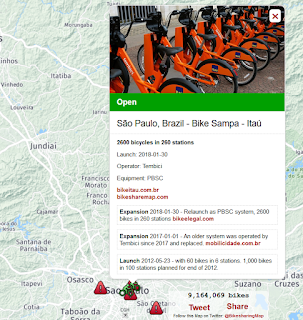


If you’re aware of a new bikeshare system or changes to existing systems, you can reach us at bikesharingworldmap @ gmail.com. The Map is a labor of love for all of our team members as we donate our time for the sake of bikeshare and to continue Russell’s decade of effort.

On behalf of our international team, we hope you like The Meddin Bike-sharing World Map.

Sincerely,

Paul DeMaio

Monday, March 18, 2019

Asset Management


Bikeshare is transit and as such needs the same attention that rail and bus systems do to keep functioning properly as they age. As most bikeshare systems around the world have launched this decade, many are needing to replace equipment that is becoming outdated and performing less than optimally after years of use and exposure to the elements. It’s not as exciting to repair or replace a bikeshare station as it is to expand a network with a new station, but in many ways it’s more important in order to maintain ridership and happy customers.

It’s necessary to keep a bikeshare system in a “state of good repair” and stay ahead of the curve so that the backlog of repairs doesn’t threaten your system’s reliability in the future. A bikeshare system is in a state of good repair when system components are properly maintained or replaced in accordance with industry standards. Customers don’t appreciate broken docks that won’t accept the return of a bike or seats cracked so badly that they’re not comfortable and soak up water when it rains only to get customers wet on their next trip. Common equipment issues for stationary assets are rust on the plates and docks; dysfunctional and/or unreadable kiosk displays; and docks with locking mechanisms that have extended well past their useful life and won’t accept a bike on a customer’s first attempt at the bike’s return. If the quality of your bikeshare system decreases, customers will bail from bikeshare to find a better functioning transport option to meet their mobility needs. Therefore, keeping a bikeshare system well-maintained is key.

Seat conditions
As stations age, it’s likely not necessary to replace the entire station, but rather replace individual components that aren’t functioning optimally. To determine what needs repair or replacement requires knowing the condition of the equipment. To do this there are asset management software tools, such as Survey123, where one can program the needed fields in the app and then use a smartphone or tablet while on-site at each station to enter the data. Fields should span across each type of asset, including plates, map frame, kiosks, and docks. It will take a decent amount of time, but regularly inspecting your system assets helps you spot and address smaller issues before they grow to bigger and more expensive and time-consuming problems. 

photo credit: Aaron Goldbeck and Iryna Bondarenko, District Department of Transportation
The appearance and functionality of stations should be considered. Appearance refers to rust, correct decals and station name, presence of vandalism and debris, presence of decals and map frame ad/public service announcement, etc. For on-street stations, let’s not forget delineators and markings. Functionality refers to the actual operation of the station, such as making sure the kiosk display is responding to touch and is legible, each dock accepts and releases a bike, key pads are working, station plates haven’t separated too much thereby creating a tripping hazard, etc. Each bikeshare vendor’s equipment has its own set of needs regarding what should be evaluated during station visits.

Rust
Knowing the actual condition of equipment will allow bikeshare operators and owners to replace components based on need rather than age. While age is an important consideration, an older infrequently used dock will last longer than a newer frequently used dock, all things being equal. With this equipment condition data, one’s limited budget can be spent more wisely.

Out of service dock
We at MetroBike assist clients with asset management to ensure longevity of their bikeshare investment. Working with our clients, we develop a complete list of assets needing condition evaluation, analyze assets on-site, report which assets need repair or replacement, and help create a prioritization of replacement needs based on the budget. Should your bikeshare organization need assistance with asset management, you can reach us at hello @ metrobike.net.


Tuesday, July 10, 2018

Please, Don't Call It Dockless


It’s time to reconsider the terms that are presently being used in much of the English-speaking world for the “dockless bikeshare” and “dockless scooter” systems that have popped up around the globe over the past couple of years. As you may have guessed, we here at The Bike-sharing Blog – the specialists in public-use bicycling – have a couple thoughts about this as it’s in our wheelhouse. 

Modern 3rd generation (high-tech) bikeshare systems that don’t need a station at which to park bikes have been around since the dawn of the millennia. However, about two to three years ago with the dawn of these systems in China, a new term was coined which explained not what these systems are, but rather what they are not – they don’t need stations and their pesky docks, so are dockless. The term “dockless bikeshare” somehow caught on.

Then more recently electric stand-up scooters hit the scene and the term “dockless scooters” was creatively coined (pardon the sarcasm) due to its similarity to dockless bikeshare. Did anyone stop to think that this term, dockless scooters, doesn’t make any sense because there were never docks to begin with.

Dockless bikeshare and dockless scooters are transitional terms available to us now as we transition to better, more descriptive and accurate terms. The term “horseless carriage” was a transitional term used in the early years of the automobile as a descriptor because at the time carriages generally were pulled by horses, but this new machine, which later was called the automobile, had its own steam energy source. 


The good news is that existing terms will satisfy the need for more accurate descriptions for these technologies. The terms “fixed bikeshare” and “flexible bikeshare” have been around since the mid-2000s and accurately describe station-based and non-station-based systems, respectively. Fixed bikeshare has stations at fixed points. Flexible bikeshare provides flexibility to customers about where to park. For the few hybrid systems out there that both allow parking at and away from stations, it can be “hybrid bikeshare” or how about “flexed bikeshare” combining both the flex- of flexible and the -xed of fixed. The term “scootershare” is also already in use, but needs the descriptor “stand-up scootershare” so as to not be confused with sit-down scooters which are also being shared.

Why reinvent the wheel when we already have good terms to ride on?

#  #  #
 
Paul DeMaio is Principal with MetroBike, LLC – the U.S.’s oldest fixed and flexible bikeshare consultancy.

Friday, May 17, 2013

Happy 6th Birthday

Today is the 6th birthday for The Bike-sharing Blog. Time flies as you're pedaling along.

In these past six years, bike-sharing has taken the world by storm. There is no one individual leading the charge, but rather people all over the globe are seeing the value that bike-sharing brings to their city, county, town, or state -- whether it's to lower traffic congestion, improve public health, or increase economic activity around the bike-share stations.

Thanks to the bike-sharing employees who balance bikes from full to empty stations and keep them and the stations functioning. Thanks to the bike transit professionals who manage the services, plan for station locations, partner with friendly neighbors and organizations, and ensure that the services run smoothly. Thanks to the advocates who support bike-sharing in their communities, demand bike-sharing in municipalities where it does not yet exist, and help push the concept to evolve and innovate to better meet the needs of even more people. And thanks to the people who use the service and don't think twice about how bike-sharing has become part of their lives and the urban fabric of their city or town.

There are bike-sharing services on every continent now with millions of people sharing bikes daily. This is a long way from where we started just six years ago. Now tens of thousand of people in New York City and Chicago are anticipating the launch of bike-sharing services this month and next. There have been details of the on-going culture clash between car vs. bike as bike-share stations begin to dot city streets. As other cities around the world have taken to bike-share, so will these too and other cities world-wide as the automobile culture fades and the bicycle culture grows and becomes mainstream. Equity and safety for all.

Thanks for your continued support of The Bike-sharing Blog for these past six years and the next six too.

Sincerely,
Paul DeMaio and Russell Meddin

p.s. - Don't forget to check out The Bike-sharing World Map and our new Twitter feed.

Tuesday, October 2, 2012

Bycyklen is Dead. Long Live Bycyklen!

The City of Cyclists won't be modernizing its bike-sharing service any time soon due to a decision by the Copenhagen City Council. They recently voted not to fund a modernization of one of the earliest bike-sharing services, Bycyklen, which was born in 1995 and is still in operation. Rather than smart cards and solar stations, this service uses a coin deposit lock and the honor system which had worked reasonably well in its early years, but hasn't been maintained properly by its present operator -- AFA JCDecaux. 

According to The Copenhagen Post, Ayfer Baykal, Copenhagen's deputy mayor for technical and environmental affairs, "defended the city’s decision not to invest in the cycle sharing scheme this year.
“They’re junk, I agree with [the Danish Cyclist Federation] on that issue. The city bike scheme, as it exists today, needs to be updated. It is old and outdated. But right now we need to prioritize.”
Deputy Mayor Baykal continues, “The city bike scheme is primarily for people coming from outside the city because Copenhageners have their own bicycles. I have chosen to prioritize better cycling conditions in Copenhagen through improved bicycle lanes and bicycle parking instead of the bicycle sharing system.”

What better way to help tourists experience the city than the way Copenhageners do - by bike? If a Bycyklen or other bike-share bike isn't available to a tourist, he or she could just as easily use a taxi or rent a car. To the environment, it doesn't matter whether the pollution comes from a resident or a tourist, but rather that the pollution is created. Also, tourists are the most profitable user segment as they contribute more financially than residents do through day membership or per minute fees.

While Copenhageners are bike-friendly, do they always bring their bike with them? I too live in a city with a growing bike mode share and frequently go by bike, but sometimes I just don't have my bike with me. The local bike-share service, Capital Bikeshare, frequently helps me get from point A to point B. I could otherwise take the train or drive.

The 150 million Danish kroner (26 million USD) will instead be used to make cycling improvements in the city, which is not a bad second place project, however, a piece of reality in how local governments are stretched thin for funding for many deserving projects. Additionally, the end of Bycyklen is near as the contract with AFA JCDecaux for the service expires October 31. Not sure what will happen after that with bike-sharing.

On a personal note, Bycyklen got me interested and excited about bike-sharing back in 1995 as I read about the new Bycyklen on-line and went to Copenhagen for a semester abroad to learn about bike-sharing and this quaint modern bike-friendly city which I, in turn, fell in love with. I was back last year in a professional capacity to work with the Cities of Copenhagen and Frederiksberg and DSB in developing the public tender for a new operator and vendor. Hopefully the Council will see the value of modernizing the bike-sharing service not only to regain a worldwide leadership in bike-sharing that it once had.