Tuesday, August 23, 2011

B-cycle and Capital Bikeshare Share Information

Take The Bike-sharing Blog Survey: Click Here


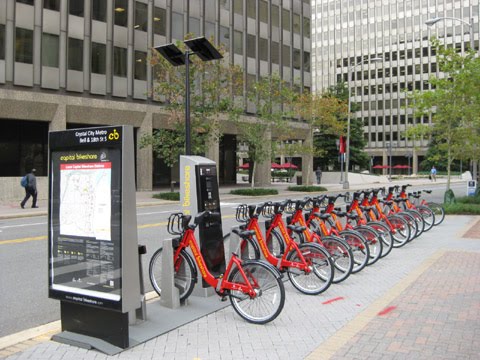
One month before its first birthday Capital Bikeshare has released a new feature on its website that allows members to review total distance, calories burned, and carbon footprint reduction for their 200 most recent trips. The distances are measured "as-the-crow-flies" in a straight line between stations. B-Cycle also boasts personal profile pages in its nine bike-sharing operations across the country. Distance in these programs is measured by a GPS device located within each bike, from which calories burned and carbon avoided are extrapolated. Members can also track the duration of their trips, allowing them to see where they may have accumulated any fees.


For those without a local bike-share, B-cycle offers the B-effect, where any individual can enter his/her zip code to find out what a B-cycle bike-share would look like in their city. B-effect uses the population of a city to determine how many "B-stands" and cycles it would need, but also calculates how many calories burned, pounds lost, carbon emissions reduced, money saved, and traffic reduced would result from just 10% of that city’s population using the service for only 30 miles. While a 10% bike mode share is enviable for ALL American cities and most around the world, by the time the B-effect page asks "Want B-cycle in your community?", it has already built quite a convincing case.

image credit: B-cycle

Tuesday, August 9, 2011

Medellín's Student-Inspired Bici-K

Take The Bike-sharing Blog Survey: Click here


(in Spanish)

This September, Medellín, Colombia will unveil 160 public bicycles in the form of a pilot bike-sharing program. The bikes, featuring GPS tracking software and swipe card stations, cost the city about $500 each and will be free to use for up to 30 minutes from 5:30am to 7:30pm. The bikes were developed by three engineering students at Eafit University, who have dubbed their bikes "Bici K". The service is modeled after Santiago’s successful bike-sharing program, where users can sign up online or at one of the automated kiosks. The program will cut down on operational costs by partnering with the local Eafit University, from which 20 – 30 students will be hired to help manage the program.

In 2008, the District Council of Bogotá, the capital and largest city in Colombia, passed Agreement 346 to establish a bike-sharing service, "Bike-Bogota", but in the two years since, there has yet to be a feasibility study. If Medellín’s system’s is assessed as a success in December, it will expand with more bikes and more stations. Hopefully, this will help encourage Bogotá to take action on its mandate.

Monday, August 8, 2011

Main Street Makeover for Tulsa Townies

Take The Bike-sharing Blog Survey: Click here


Tulsa Townies is a recreational community bicycle program which promotes healthier lifestyles and began in Tulsa, Oklahoma, USA in August 2007. It was the first application in North America of a solar-powered, automated, network of stations which allowed pick up and drop off of bikes at any of four locations along the Tulsa River. This program was the seed of 3rd generation bike-sharing in North America that grew first into the Humana Freewheelin' program and then matured into the B-cycle bike-sharing services and spawned Decobike as well.

Last week Tulsa Townies, which is sponsored by the Saint Francis Health System and funded by the William K. Warren Medical Research Center, underwent a complete makeover with 50 new bikes and three new advanced electronics stations, designed by Sandvault, that have video surveillance to watch over them. (But what are they looking for?)

Also last week, Oklahoma City, Oklahoma, USA, announced it was planning to join the growing list of American cities offering its citizens bike-sharing as public transportation. At the same time, as highlighted in The Bike Sharing Blog, a study in The British Medical Journal reported that bike-sharing saves lives. Maybe these events can all spur the Townies into fulfilling its healthier lifestyle ideal to more of Tulsa by moving from just being a recreational program into bike-sharing as transportation. For now, enjoy a ride along the Tulsa River Parks with the Townies. It's free with only a $10 refundable deposit!


Friday, August 5, 2011

The Bike-sharing Blog Survey


The Bike-sharing Blog is interested in better understanding our audience and what we can do to make the Blog even better for you. We have a short survey that will take two minutes to answer and we would appreciate your response.

Click here to take The Bike-sharing Blog survey.

Thank you from Paul, Russell, and Jesse at The Bike-sharing Blog.

Bike-sharing Saves Lives


A new report in The British Medical Journal provides more analysis that confirms: bike-sharing saves lives. For this study, titled "The health risks and benefits of cycling in urban environments compared with car use: health impact assessment study" by David Rojas-Rueda, Audrey de Nazelle, Marko Tainio, and Mark J. Nieuwenhuijsen, the authors surveyed 181,982 Bicing subscribers in Barcelona and found "[c]ompared with car users the estimated annual change in mortality of the Barcelona residents using Bicing (n=181,982) was 0.03 deaths from road traffic incidents and 0.13 deaths from air pollution. As a result of physical activity, 12.46 deaths were avoided (benefit:risk ratio 77). The annual number of deaths avoided was 12.28. As a result of journeys by Bicing, annual carbon dioxide emissions were reduced by an estimated 9,062,344 kg." In other words, bike-sharing is good for you and the air we breathe.

Bike-sharing services are usually implemented by transport agencies. With research such as this, it shows that bike-sharing is an interdisciplinary matter and therefore should garner further cooperation by public health agencies as some jurisdictions already have begun.

image credit: Barcelona attractions

Tuesday, August 2, 2011

Taking Care of Business -- the Vilnius Way

Today's post has little to do with bike-sharing, but it's a funny video coming from Vilnius, Lithuania showing Mayor Arturas Zuokas taking care of business and removing cars which are illegally parked in a bike lane with his own personal style -- using a tank. Whether real or a While set-up, Vilnius has no bike-sharing service yet, but with the political will of such a mayor to improve conditions for cyclists, I wouldn't give it long until they see a bike-sharing service of their own.

Monday, August 1, 2011

The Bike-sharing World: First Week of August 2011

A lot has been going on in the Bike-sharing World over the past few weeks. Let's get started.

Good News in Europe:

Paris: Vélib' celebrated its 4e anniversaire last month by now averaging 75,000 daily trips on the ubiquitous grey bikes. After a period of flat growth, the first quarter of this year has seen the greatest increase of usage yet, and 20,000 new subscribers according to France3.


London: For Boris Bike's first birthday a few days ago, Mayor Boris Johnson confirmed that Barclays is extending its sponsorship of the system with another £25 million ($41 million USD) to expand the popular program into the western Boroughs of Hammersmith and Fulham in 2013. This is in addition to the current eastern expansion for next summer's Olympics. Barclays Cycle Hire, with only one forth the number of bikes as Paris, realizes around 25,000 trips daily, around 1/3 of the 75,000 in Paris. That is definitely something to bank on!

Newcastle on Tyne, UK: A new mobile phone bike-share scheme, Scratchbike, has begun with 150 bikes tethered to 15 racks in the central Newcastle. The program is sponsored by NE1, the Newcastle Business Improvement Company. It is scheduled to be a city-wide service, which incidentally began as a student-run program at Newcastle University.

Dublin, Ireland: Dublinbikes two weeks ago reached an all time high of 6,280 rentals in one day! That's around 12 trips per bike per day! Dublinbikes is at the top of the list of the most successful bike-sharing systems in the world. This summer it has added 4 new stations and is adding another 100 bikes to bring its fleet up to 550.

Two new bike rental schemes make riding the Inter-City Rails easier:
Belgium- Blue-bike recently set up 35 locations with around 1,000 bikes at train stations in cities and towns throughout the northern part of Belgium. It's mostly a pick up and return to same location system. It is similar to the original concept of the Deutsche Bahn Call-a-Bike system at rail stations.  As Call-a-Bike has matured, it has become a multiple fixed locations bike-sharing system in many German cities. One may pick up a bike at one location and return it to another. The service is similar to The Netherlands' OV-fiets service.The Bike-sharing Blog hopes the same for Blue-bike as it matures. An online sign up for a membership card is needed to rent these bikes. The card costs €31 ($45 USD) and the daily rate of €3.50 ($5 USD). Also in Belgium, a bike-sharing system with 240 bikes is coming to the city of Namurs.


United Kingdom: Brompton Docks is a "left luggage lockers" folding bike rental system piloted this summer at a suburban London train station. These Brompton folding bikes must be replaced in the same set of lockers from which they were removed. Renting cost
starts at £4 ($6.50 USD) for one day to £1.60 ($2.60 USD) for 23 days or more. As with the Belgium system, a membership and a smart card are needed.

And don't miss the OBIS handbook:
The Optimizing Bike Sharing in European Cities (OBIS) handbook has three years worth of data from studying bike-sharing in 10 European counties to identify the best practices, success factors, limits and market potentials, and the optimized strategies. This guide has published in it the authors' key findings and recommendations as a comprehensive manual in the form of a handbook. Read The Bike-sharing Blog's March posting about the OBIS Project and Final Conference.

Bad News in Europe:

The ax falls on bike-sharing in Aix-en-Provence, France. After almost four years V'Hello said its last adieu in May to the citizens of this southern French city. With only 143 users, the municipal government felt it was financially better to cancel its contract for the 200-bike, 16-station service with JCDecaux rather than to keep it. According to LePoint, even with low usage, the outdoor advertising company wanted to charge Aix-en-Provence over €400 ($575 USD) more per bike per year than it charges Paris to maintain the system.

Good news in Eurasia:


Batumi, Georgia: This resort town on the Black Sea now has a 120-bike and 10-station bike-sharing program as BatumVelo began three weeks ago. The program uses the Smoove technology. Whether one subscribes or is a casual user, there is no free usage time. For every 15 minutes of use the subscriber pays 0.50GEL ($0.30 USD) or the casual user pays 0.75GEL ($0.45 USD) whether going to the beach or pedaling around town.


Good news in North America:

Long Beach, New York: The South Beach Miami DecoBike has landed a 400 bike and 40 station contract making a beach head in New York State. Long Beach, New York, which is just next to New York City on Long Island, is scheduled to have its fully operational bike-sharing program in September. Getting to the sands of the Atlantic Ocean from the Long Island Railroad Station will be a breeze on a DecoBike Long Beach.

While talking about New York, for the last two years at Summer Streets in New York City, there have been bike-sharing demonstrations as part of the activities. Will there be a bike-sharing contract announcement this year?

The Bike-sharing Blog expects Chattanooga, Tennessee also to begin a bike sharing program soon. According to Outdoor Chattanooga, there will be 30 bike stations located around the central business district, the UTC campus and the North Shore. The system will use the same style bike as the Washington, DC/Arlington, Boston, and Minneapolis programs.

Good News in Asia:

Hangzhou, China: According to the HHN Information Center, the Hangzhou Public Transport Company says that, as of now, there are usually around 200,000 daily usages of the system. Generally, each bike is used around 5 times a day.The the highest single day usage was 320,000 rides. There are currently 2,416 service points for 60,600 bicycles.

To keep up with the ever changing Bike-sharing World, keep referring to the The Bike-sharing World Map


Thursday, July 28, 2011

Boston on Massachusetts Bay begins Bike-sharing today with The Hubway


This morning New Balance Hubway is up and running in Boston. This brings Boston into the select group of North American cities with major bike-sharing systems. Although New Balance Hubway is planned as a regional system, it starts with a Phase I of around 600 bikes in about 60 stations in the central parts of Boston. Already the adjacent municipalities of Cambridge, Somerville, and Brookline are exploring having Hubway stations, according to the Boston Globe. There is a handy user-friendly Request A Station Locator Map where anyone can suggest a station location in the region. The expansion of the system is a shoe-in with the New Balance Company as its naming sponsor.


Even with only 600 bikes, New Balance Hubway has installed a few large docking stations in the expectation of a many members. Although the system will only run spring through fall, the yearly subscription of $85 is a bit more than its sister program Capital Bikeshare in Washington, D.C. and Arlington, Virginia. For $10 more, you get a few months less. Both services are operated by the same company, Alta Bicycle Share, however, pricing is set by the governments for Capital Bikeshare and likely the same is true with Hubway.

In a very interesting twist on usage fees, New Balance Hubway is charging around 25% more to its 1-day and 3-day "casual" users over what it charges its annual members who keep the bike over the first 29 minutes (below).


The Bike-sharing Blog welcomes Boston and its region to the bike-sharing world.


images: The Bike-sharing Blog and The Hubway

Wednesday, July 20, 2011

Golden’s Community Bike-share


The town of Golden, British Columbia has shown the world that small towns can join the bike-sharing world without multimillion-dollar investments. Two years ago, the Golden Active Transportation Committee met with the intention of setting up a bike-share “that would work well with our community,” said Lisa Reinders, manager of leisure services in Golden. This past March 27th, their dream was realized. The two hubs are located at a campground and a hostel, where the staff of these businesses sign up users, sell swipe card passes, and keep the stations clean. In return, the businesses retain 75% of the rental fees they sell, while the other 25% goes to the Town of Golden, the operator. The rental fees are $10/day, $35/month, and $60/season, which runs from May to October.


A new user can sign a waiver at the campground or hostel, and after paying, can obtain a swipe card to check out a bike for up to 30 minutes at a time. The hubs, which are powered by solar panels, were purchased by the Town of Golden from Sandvault, a bike-share vendor. The cost of the stations, including 15 Kona bicycles and software maintenance, came to $37,500, or $2,500/bike. To finance this investment, Golden benefited from British Columbia’s Resort Municipality Initiative, where 13 resort communities receive a portion of the town's hotel room tax to invest in local projects. As the staff of the campground and hostel do most of the operational labor, the town of Golden only needs to offer two part time employees to provide oversight, maintenance, and occasional technical support for the program. The town plans to add 15 more bicycles and two more stations in a subsequent phase of the program. Golden's model provides an intriguing example for smaller towns that want to offer bike-sharing without undertaking large capital investments.

Image credit: Town of Golden

Thursday, July 14, 2011

The Bicycle Dividend


As New York City began rolling out extensive bike lanes this spring, John Cassidy of The New Yorker raised staunch opposition, suggesting that the point has been reached where the additional costs of bike lanes to motorists and pedestrians are greater than the benefits they provide to cyclists. The Economist promptly published an article addressing the economic fallacies of Cassidy’s crusade, delineating the dramatic externalities of urban auto use, including respiratory damage from auto-generated ozone, climate changing carbon dioxide, road breakdown, and congestion, not to mention accident fatalities and obesity. As fuel taxes are too low to cover road maintenance, let alone the rest of these externalities, none of which bicycles exhibit, New York would be better off encouraging fewer cars and more bicycles, The Economist argues.

Nancy Folbre, of UMASS Amherst, takes her economic analysis a step further, positing a concept of “The Bicycle Dividend.” She turns the traditional economic concept of demand stimulating supply on its head, showing that increased supply of bike lanes encourages more cyclists, which makes cycling safer, which in turn attracts more cyclists, which begins to shift cultural perspectives on cycling, which in turn attracts more cyclists, which encourages businesses to offer showers and other resources for their bike- commuting employees, which in turn attracts more cyclists, etc. This virtuous cycle, while taking time to evolve, can be spurred by increased supply of bike infrastructure. Finally, she quotes a study by her colleague showing that each dollar spent on bike paths creates more jobs than each dollar spent on roads, in addition to providing more public welfare.

Discouragingly, Armin Rosen of Alt Transport published a reaction to Folbre’s article arguing that drivers won’t necessarily stop driving because bike lanes have increased. Rosen concludes, “There is a ’biking dividend’—but it might have more to do with a city’s prestige and reputation, as well as its local biking economy, than with any unproven ability to take cars off the road.” This reveals Rosen’s greatest blunder, as he fails to recognize the connectedness of a city’s reputation, biking economy, and car concentration. As Folbre’s virtuous cycle illustrates, the three build off each other, so if a city would benefit from fewer cars, as The Economist suggests New York would, then it would do well to invest in bike infrastructure. This, in turn, will increase bike commuters, resources for bike commuters, and begin to change pervasive cultural attitudes towards bikes. Further, a NICHES report showed 7% of people who use Lyon’s Velo’v bike-share would have driven a car if the program did not exist, showing that enhanced infrastructure does take cars off the road.

This issue lies at the crux of city planning, and Cassidy’s accusation of “the bike lobby’s effort to poach on our territory” lays bare his belief that the streets, the majority of most cities’ public space, belongs to drivers, and any reconfiguration of this historical precedent is an affront to their rights. Fortunately, we are now afforded the hindsight to see that basing our transportation system on cars is hurting our bodies and our environment, in more ways than one. After all, here we aren’t just talking about public transportation, but what kind of transportation we, as a public, wish to incentivize. It’s time for our leaders to make public space work for our best interests as a public, not just for the best interests of drivers. The dramatic proliferation of bike-sharing services across the world, and the necessary bike infrastructure to serve bike transit riders, reveals a change of course. The expansion of public space afforded to cyclists will only facilitate the social and infrastructural change necessary needed to make cycling a viable urban transportation option, and make our cities better places to live.

Image credit: New York Department of Transportation

Tuesday, June 28, 2011

Japanese Bike-share is Electric


Kitakyushu City, in the Fukuoka Prefecture of Japan has launched “City Bike”, an electric bike-sharing program. In order to earn its title of environmental capital, the city contracted the non-profit Town Mobile Network Kitakyushu to operate the bike-share service. Since March 27, 2010, 116 bikes have been available at 10 stations throughout the city’s downtown area. July 2010 saw an average of 41 people ride a city bike each day.

Users sign up for the program online or at one of three manned stations where they receive a membership card. With their card, a customer can release a key and battery from one of the many electronic stations throughout the city. The customer may can then unlock the bike with the key and insert the battery into the bike, at which point they are ready to ride. The bikes cost 105 Yen (US $1.27) per hour, with additional fees for keeping a bike for over 5 hours.

image credit: Kitakyushu City

Sunday, June 26, 2011

Arlington's Interactive Mapping Tool for Capital Bikeshare

Arlington County, Virginia, USA has a public process where it provides many opportunities for Arlingtonians to contribute to ensure the best possible results are created in providing public services for its citizens. Time-consuming, but thorough, "the Arlington Way", as the County calls it, is being used for the selection of the County's next round of 30 stations, growing its share of the regional Capital Bikeshare service to nearly 50 stations. MetroBike, LLC is the program manager for Arlington's fleet, so I wanted to share what we're doing to generate public comment, so that the new stations will best service folks who live, work, or play in Arlington.

The public process includes a public meeting, to be held tomorrow (6/27) for the general public to comment on locations in the dense urban corridor where the stations are planned for this fiscal year. Next month we will present again the locations to civic associations for those neighborhoods which will receive a Capital Bikeshare station. We'll also notify businesses and residents who are near proposed station locations through a letter.

An innovative public outreach tool that I'm excited about is an interactive map, developed by BikeArlington, which will allow the public to comment on our proposed locations and suggest locations of their own. On the interactive map, County-proposed locations are shown in yellow, community-proposed locations are in green, and existing stations are shown with the Capital Bikeshare logo. The public may like or dislike any location and comment with their reason. All comments for any respective proposed location are shared with the viewer by clicking on a proposed station. With over 150 comments since the webpage was launched last week, the interactive map is proving popular.

Through all this public feedback, we'll be sure to install our stations where people will use them most.

Monday, June 20, 2011

The Bike-sharing World: First Days of Summer 2011

Asia:

Korea - The first day of November 2010, Seoul, Korea officially began an experiment in bike-sharing with a one year pilot program called SeoulBike. Serving just two small areas of this huge metropolis, this month the system with only 440 bikes in 43 stations surpassed 110,000 trips according to Seoul's City Government. Even in such limited areas, each bike is used 1.7 times a day. It would be more, but the initial "no charge" usage period is 4 hours! Each additional 1/2 hour after that is 1,000₩ ($1 USD). The subscription rates are: 7 days for 3,000₩ ($3 USD), 30 days for 5,000₩ ($5 USD), 6 months for 15,000₩ ($15 USD) and at the beginning of the pilot, the 1-year subscription was 30,000₩ (about $30 USD). We'll come back and take a look at this system as it moves on from its pilot status and grows throughout other areas of Seoul.

China - It's getting interesting with China's two mega systems. It was announced by the Hubie Daily News that Wuhan, China's system now has 51,500 bikes, which is about same number as Hangzhou, China's system. Wuhan plans to expand its system to 70,000 bicycles by the end of this year. Hangzhou currently with about 53,000 bikes and expects to have 61,500 bikes by the end of this year. By 2015, Hangzhou projects to have 100,000 bikes according to China's TLNews. In this bicycle race, which of these cities will claim the "Maillot Jaune" (or yellow jersey, to borrow Tour de France parlance) of the largest system in the world at the end of the year? Speaking of the Tour de France, the entire country of France has less than 42,000 bikes in all of its public bike-sharing programs! China is again the Kingdom of Bicycles.

Europe:

France - Last week the 100,000,000th trip was taken on a Vélib' in Paris. As proof that bike-sharing is such a global phenomenon, the event was celebrated by the Japanese television show "Yatta" which means "You did it!"


Australia:


Australia - Brisbane started CityCyle at the beginning of October 2010. There are around 100 stations and around 1,000 bicycles. Washington, DC started Capital Bikeshare at the end of September 2010 with also around 100 stations and 1,000 bikes. Both cities have low lying central business districts and hilly residential areas. Both cities get hot in the summer. The City of Brisbane has three times the population of the city of Washington, but as a region, only one-third the population of the DC-area. A more striking difference is the respective bike-sharing usage numbers. Over about the same period of time Washington has had over 550,000 bike usages and Brisbane has had around 50,000. There are 5,200 subscribers to CityCycle and 15,200 to Capital Bikeshare. Both cities are planning large expansions of stations and bikes for their respective systems during 2011.

We at The Bike-sharing Blog have to ask: What is going on "down under" that has put the Washington system so much on top?


Wednesday, June 1, 2011

The Bike-sharing World: First Week of June 2011


Transportation Integration in Europe:

Starting today, Deutsche Bahn, the German railway company, is offering the Mobilitätskarte (Mobility Card) in Berlin. This could be the start of the future for bike-sharing membership cards. This card not only offers access to the new Call-a-Bike StadtRAD system, it also is an all-zone VBB, or Berlin Brandenberg Public Transit, pass which provides access to train, tram, subway, and bus, in addition to access to a new all electric car-sharing program. All that is missing from this card is parking meter payment!

The card costs €78 ($112 US) a month which includes a €50 ($78 US) credit for use of the car-share program. Since it is a trial, the card is only available for sale this month, but can be renewed for three months. The Bike-sharing Blog will be watching the acceptance of this card by bike-share users in Berlin. This type of all encompassing bike-share transit card will be a hallmark of 4th generation bike-sharing.

Known for its many flavors of craft beer, Belgium now will be known for its flavors of bike-sharing with the launch of A-Velo in Antwerp on Thursday June 9th. This will be another Clear Channel European system. With 85 stations and 1,000 bikes to start, the system will grow to 150 stations and 1,800 bikes in two years. The yearly memberships, which are available now, cost €35 ($50 US). There is a weekly pass at €7 ($10 US) and a daily at €3 ($4 US). As is customary, there is no charge for the first 30 minutes and each additional 30 minutes escalates in price. An interesting twist for membership is that if users keep a bike for 4 or more hours on three different occasions he or she will loose the bike-sharing privilege!


In Asia:

Kudos to Elizabeth Press of StreetFilms. She made a great video on the huge bike-share program in Hangzhou, China.


Since she filmed this in depth study on the largest bike-sharing system in the world, the Hangzhou Public Transport Group has been adding more bikes to reach 60,600 bikes at 2,711 service points for this year.


images: DB, A-Velo, video: Streetfilms

Friday, May 20, 2011

Bike-sharing Designed to Fit More than the Average José

Gandia, Spain is the one of the first cities to adapt its bike-sharing service, labici, for persons with disabilities. With 500 bikes at 40 stations, the municipality decided to introduce bicycles for those with disabilities as a trial program. According to laprovincias, the Councillor for Traffic and Mobility for the City of Gandia, Vicent Mascarell, is proud of his city's "commitment to equality" to persons with disabilities." A successful experiment here could lead to more bike-sharing services following Gandia's lead.

In the bike-sharing world as May winds down, Hawaii B-cycle (Kailua, USA), Boulder B-cycle (Boulder, USA) and StadtRad Berlin (Berlin, Germany) started today. Capital bIXI (Ottawa, Canada) started on Wednesday and Madison B-cycle (Madison, USA) starts on Sunday. At this rate of new service launches, The Bike-sharing World Map will soon be rolling with more bike icons than blank space!

Happy Bike to Work Day for readers in the United States!

[Check out Russell Meddin's guest article this month at Renault's Sustainable Mobility website. - Paul]