Showing posts with label Smoove. Show all posts

Sunday, May 27, 2018

The Need to Hybridize Bikeshare


Third generation “fixed” or “station-based” bikeshare and “flexible” or “dockless” bikeshare both started around the same time around the dawn of the new millennium. Clear Channel’s SmartBike and Deutsche Bahn’s Call a Bike are two of the oldest station-based and dockless systems, respectively. Both fixed and flexible bikeshare have their own unique set of benefits and detriments however it’s time to hybridize them to a greater extent than has happened at the present in order to achieve the benefits of both while lessening the detriments of each.

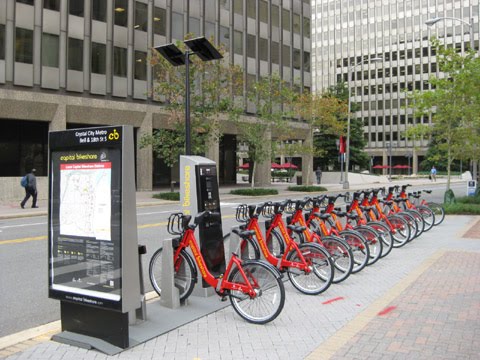
The benefits of fixed bikeshare are that it: 1) provides order in an urban environment as the station and its bikes use a defined space, 2) provides the customer a set location from which to rent a bike. In an urban environment where every square meter of space is spoken for, a fixed system ensures formality of the bikes being parked as was intended in an orderly way that doesn’t negatively impact other street users. Additionally, as we are creatures of habit, starting off one’s morning commute in the same manner and location each day provides a level of comfort for a customer, assuming that bikes are available.

However, issues with fixed bikeshare are that it’s expensive for the system owner to purchase a station as they can easily cost $50,000 USD. Additionally, finding sufficient space for a 50’ x 6’ station, for example, and an adjacent site from which to rebalance it can be time-consuming to obtain necessary approvals and difficult to find a big enough area in an urban environment.

The benefits of flexible bikeshare are: 1) the bikes don’t require the same level of investment as does station infrastructure, and 2) servicing less dense areas -- where usage is lower and distances are greater – is comparatively quite economical.

However, a major issue with flexible bikeshare is that the bikes sometimes aren’t parked well by the public in denser neighborhoods, leading to obstacles on sidewalks and streets as well as using up valuable public space.

Therefore, hybrid fixed/flexible systems with stations in denser neighborhoods but not in less dense areas should be made commonplace by the cities and counties who own bikeshare systems and the bike and station vendors they work with. This would allow for a more economical transit service to implement and operate along with more orderly placement of bikes – the latter of which has been a great concern to the public.

An additional benefit is that overflow parking can easily be created by customers at fixed systems by the flexible systems by locking the flexible bikes either to adjacent inverted U bike racks as nextbike does in Budapest, or to the docked bikes themselves as Smoove does in Paris. This decreases the need for rebalancing the full stations as additional limited capacity can be created.

There are a few vendors as I’ve mentioned above that have seen the light and necessity of hybridizing, including nextbike (below), Call a Bike, and Jump. Smoove is to have this in Paris in the future. It would be wise for more vendors to follow this path for the benefit of bikeshare customers around the world who rely on bikeshare to move around their region.

Locking a nextbike adjacent to the station in Budapest, Hungary, credit: MOL Bubi
The dawn of pedelecs has arrived into bikeshare and flexible pedelecs are going to need stations that are hard-wired to an electrical source to recharge. Manual swapping of batteries for a large fleet would be a grand task and is merely a short-term solution.

With hybridization of fixed and flexible technologies, the best of both worlds unite. There will be roadblocks, such as competition between vendors and lack of cooperation between municipalities and operators but hybridization will happen because it’s too good of an idea to not.

Saturday, July 15, 2017

Vélib'- Ten Years Old


On July 15, 2007, then Paris Mayor Bertrand Delanoë opened 10,600 bikes in 750 self-service rental stations to Parisians and the world.  For only €1 ($1.14 US) a day, one could take unlimited rides of 30 minutes each or less. It seemed to be a transportation revolution.


Vélib' success made the world embrace self-service public bicycles.
It might not have been the first program,
but its notoriety changed the world.

Video on how it all began for Paris

In 2007 there were only around 20 self-service public use bicycle programs throughout the world.  Now ten years later, there are over 1,350. Many of them are direct copies of the JCDecaux design and function seen in Vélib'.


What at first might have seemed a curiosity, automated self-service bicycle rental has turned into a social phenomenon. According to JCDecaux, the current operator of Vélib', every minute 75 Vélib' bikes are rented in Paris. On average each bike is used about 6 times a day. In the last 10 years over 300,000,000 trips were pedaled on Vélib'. Now, there are 300,000 annual subscribers to the system in the City of Lights.


The Next 15 Years


January 2018 will bring, Vélib’ 2.0, with a new design, a new service, and a new operator: the Smoovengo consortium will replace JCDecaux. It will introduce what Smoovengo bills as the "4th generation" in self-service bicycles. This will include 30% of the fleet as electric assisted pedelecs. The maximum speed for the electric assist pedelecs will be set at 25 km/h (15.5 mph).  Weighing 20.6 kg (45 lbs.) the regular pedal new Vélib’ will be "lighter and stronger" than the old one at 22.7 kg (50 lbs.). 


The new "padlock fork will help prevent theft" from stations and while parking away from stations. To abate the annoyance of Parisians, who have found stations full when returning a bike, the system of will allow "depositing bikes at a station even when all the places are already occupied".  Each bike will have "embedded electronics" with a handlebar equipped with an on-board communication system (the Smoove Box) that is self-powered by a dynamo that will allow connecting a smartphone for way-finding and information.
Illustration of the Smoove Box 
Congratulations to Vélib', the old and the new. 


Vive les vélos en libre-service & Vive le 

Vélo Liberté 


images & information: Vélib' (logo & Video) Franceblue l'Express, Smoove


Russell Meddin

Keep in touch with The Bike-sharing World with The Bike-sharing World Map. It is the premiere resource for information on Public Use Bicycle programs and a complement to The Bike-sharing Blog.
The map can be viewed at www.bikesharingmap.com.

Follow the Map on Twitter@BikesharingMap   

Thursday, October 20, 2016

The African Continent - The Third Week of October 2016

AFRICA
Morocco
Marrakesh
Medina Bike Marrakesh Morocco
The first public use bicycle program on the African Continent will begin on November 7, 2016.  Medina Bike will launch with 300 bikes in 12 stations for the opening of the Congress of Parties, COP22, of the United Nations Framework Convention on Climate Change, UNFCCC, in Morocco. According to InfoMédiare the program will have equipment from the French company Smoove.

ASIA
China
Shenzhen
Mobike Light
This week Mobike, the free floating Chinese public use bike program, has expanded into Shenzhen, China. Starting in April 2016 in Shanghai, the are now Mobikes in Beijing, Guangzhou and Shenzhen according to LeiPhone.com. Also this week, Mobike introduced a new Mobike Light bicycle. According to the Shanghai Daily, this bike will first be deployed in the Baoshan District, just north of Shanghai. It will cost around 7¢US per 30 minutes to use this new bike. One half the price of using the original Mobike! Between these two bicycles, Mobike hopes to have 100,000 bicycles on the streets of greater Shanghai by the end of the year. That would overtake Hangzhou for the title of the city with the world's largest public use bicycle program.

EUROPE
Germany
Berlin
Nextbike Berlin, Germany
This week Nextbike started installing a pilot program running for the month of November in Lichtenberg, Germany. This is a test to make ready for its deployment of 5,000 bikes in 700 stations next year in the city of Berlin. The program is to replace the 1,500 bike Call-a-Bike system currently in Berlin. According to Berlin.de and Berliner Kurier, the City Senate has told Call-a-Bike to remove its bikes and stations, but Deutche Bahn, Call-a Bike's parent company, says it will replace its system with a new one in Berlin. Stay tuned for reports on this teutonic shift!

NORTH AMERICA
USA
Wisconsin
B-cycle Dash
B-cycle Dash+
B-cycle introduced two new bicycles to add to their offering for the public use bicycle market. The Dash has an 'on the bike user interface' that could be used in a 'free floater' dockless set up. It will be available soon and is compatible with current B-cycle programs. Also debuted, in prototype form, is the Dash+, a pedelec, which will be available in 2018. Both bikes can be accessed by mobile phone applications and a have a handle bar electronic screen to display navigation and information.

Texas
Austin

The North American Bikeshare Association
           2016 Annual Conference is November 9-11                                             Austin, Texas USA
This is the conference to attend in 2016 for all information you will need to know about Public Use Bicycling whether in North America or not! 
For information and registration: www.nabsa.net

images: Smoove, Mobike: Liephone, Nextbike: rbb/24, Bcycle, Digital Journal

Russell Meddin

Keep in touch with The Bike-sharing World with The Bike-sharing World Map. It is the premiere resource for information on cities with Public Use Bicycle programs and the complement to The Bike-sharing Blog. The map can be viewed at www.bikesharingmap.com.

Follow the Map on Twitter@BikesharingMap   

Friday, June 28, 2013

A Bike-share Wish Might Come True

Mayor Serge Godard awards the first membership to Patricia
Sometimes it is the little stories about bike-sharing that really demonstrates how transformational and important it is in peoples lives.  Since New York City began Citi Bike at the end of May and Chicago's roll out Divvy today, there has been one bike-share program starting almost every two days throughout the world. The one that caught my attention, happened yesterday in Clermont-Ferrand, a small city of 150,000 people near the center of France.


C.vélo, System: Smoove Box
The very first person to become a member of the city's new bike-share program, C.vélo, was an unassuming woman named Patricia. Since she moved to Clermont-Ferrand, she has waited patiently hoping for bike-share to begin there. She knew it would make her life easier. How did she know? She was the very first subscriber to Vélib' in 2007 according to the Vélib' customer service center in Paris! 

Take heart all of you around the world. If you are patient and wish hard enough bike-sharing will make it to your city or town!


The Bike-sharing World Map 
This is the #1 resource for bike-sharing systems world wide. It shows new systems coming online which might not be covered in The Bike-sharing Blog. With constant updates, it is  the best way to keep up with the ever changing bike-sharing world.

Follow the Map on Twitterhttps://twitter.com/BikesharingMap

See the O'Brien Global Bike Share Map. It shows real time bike usage in 100 Cities!

image: France 3Cyber Bougnat

Russell Meddin              bikesharephiladelphia.org

Friday, October 21, 2011

The Bike-sharing World: The last week of October 2011

Europe


UK: London - The little queen, the Prince and the Princess


In France, an endearing term for the Vélib' bikes are the petites reines, or little queens. This gives Parisian bike-sharers an air of royalty. Recent reports in British tabloids say that London royals Prince William and Princess Kate are using the little queens of Barclays Cycle Hire to get around London when they are in town visiting that other Queen. 


According to the Evening Standard, the royal couple have been seen using the bike-sharing system around the city. Their usage has been confirmed by a spokesperson from St. James Palace. It seems though that the royal couple does not use their "Boris Bike Tandem" wedding present, as seen in The Bike-sharing Blog in April, but travel on their own little queen.


Cyprus: Nicosia - easyBike


On October 26th, easyBike will be launching a new bike-sharing system in Nicosia, Cyprus. There will be around 300 bikes distributed through 27 stations in the greater Nicosia area. The system is a collaborative effort between the Greek company easyBike and the French company Smoove.


North America:


USA: Washington, DC - Raising More Capital


In less than two weeks, Washington, DC's and Arlington, VA's Capital Bikeshare will increase the cost of its causal user daily pass from $5 US to $7 US and change the $15 US 5-day pass to a 3-day pass, reports The Washington Post. 


Also, a recent decision will now allow Capital Bikeshare stations to be placed in one of Washington's most visited tourist areas, the National Mall. Could it be that the idea behind raising the price is the hope that now many more of the thousands of visitors to the Nation's Capital will use the system to sight-see and therefore help raise the capital needed to expand Capital Bikeshare!


Chattanooga, Tennessee
News reports out of Chattanooga say that Bike Chattanooga, the 300-bike/30-station system expected to launch next month, has been delayed until sometime in 2012. It seems that elements of the proposed system can not meet the "Buy American" clause of the Federal Transportation funding at this time.


Update: October 26, 2011, In response to what was reported in local Chattanooga news concerning the postponement of the launch of Bike Chattanooga, Philip Pugliese, Bicycle Coordinator, Outdoor Chattanooga, has informed the Bike-sharing Blog that the current system delay is fully associated with production timing and has nothing to do with Buy America or other Federal Transportation Administration issues. He wrote that while complexities associated with federal funding did take longer than expected, all have been resolved to everyone’s satisfaction. 


South America


Columbia: Medellín - Students Graduate


Last week, the student inspired Bici-K bike-sharing began operation in Medellín, Colombia. The Bike-sharing Blog in August reported on these efforts. This inspiration has now become EnCicla which has deployed 145 bicycles in 6 stations over two different areas of Medellín. While it appears that the program was created to facilitate easier connections between two major universities and public transit, the system will have limited enrollment. 


EnCicla offers bikes for urban and trail use, so it is available for both transportation and recreation. The system was financed by the metropolitan government and the universities. We hope to see this program prosper and expand to serve all of Medellín.


images: Royals - BarclayseasyBike, The Bike-sharing Blog, Universidad Eafit 


Russell Meddin     bikesharephiladelphia.org

Thursday, April 15, 2010

The Bike-sharing World this Week


North America

Toronto, Canada just might finally get a new bike-share system. After on again - off again negotiations for over a year, the Toronto City government is close to signing an agreement with Public Bike System (PBS) of Montréal, Canada to set up a 1000 bike, 80 station program to start a year from now in May 2011. According to cyberpresse.ca, Public Bike System will pay the $4.8 million to install the system and cover the $1.3 million projected yearly operating cost. In return, PBS is asking for Toronto to guarantee the investment until usage fees and advertising revenue cover the initial cost. After that, all revenue from the system, above the operating cost, would be shared between Toronto and PBS.

Also in Canada, Montréal wakes up its BIXI system from its winter hibernation earlier than originally planned. More than half of the system's stations will be operational on April 20, 2010 in anticipation of the 40th anniversary of Earth Day.

Europe

This week bike-sharing began in Valence, France and announced in Valence, Spain.

Libélo began service to Valence and it’s surrounding towns in the Sud Rh
ône-Alps part of France. The system has two parts: Regular bike-sharing with 160 bikes in 18 stations using the Smoove “Key” system (Bike-sharing Blog September 21, 2009) where the first 30 minutes usage is at no charge. The daily rate is around US$ 1.35 and the yearly subscription is US$ 20. Long-term bike-sharing is available with 200 bikes which can be kept for 3 to 11 months at a charge of around US$ 15 per month. These bikes are not available at the stations.

Valencia, Spain (Valence in French) signed an agreement with JCDecaux to begin a 2750 bike program with 275 stations. This Cyclocity bike-sharing system is tied to a new 20 year street furniture advertising contract with the city. This is the 5th Cyclocity system for JCDecaux in Spain.

Asia

In preparation of the Shanghai Expo 2010 “Better City Better Life,” the Shanghai bike-share & bike rental system, Rent Me a Bicycle, is expanding for the May opening of the Expo. At least 40 new stations or “Bicycle Hot Spots” will be near the Expo area to service the nearly 70 million expected visitors. The bikes are accessed by a stored value RFID (radio frequency identification) card which serves as a deposit and gives 100 ride credits for around US$ 30. Very short rides, after re-docking the bike, are rewarded by adding credits to the card conversely, keeping the bike for longer periods will subtracts credits. The Shanghai Rent Me a Bicycle system plans to expand to 3500 “Bicycle Hot Spots” throughout the entire city by 2012.

Image credits: ibiketo, Libélo & RentMeBike

Russell Meddin - bikesharephiladelphia.org/